Challenge & under attack mode
A challenge asks the browser to prove it is a real browser before it reaches your site. It needs no third-party service (no CAPTCHA provider) and stores nothing on the server.
Challenge types
| Type | What the browser does | Stops |
|---|---|---|
| JavaScript (proof of work) | Solves a small computation, usually within a second or a few | Bots that don't run JavaScript; makes mass requests expensive |
| Cookie check | Accepts a cookie and sends a form back | Simple scripts and HTTP clients |
Visitors who pass get a signed cookie bound to their IP (optionally also their browser) and are not challenged again until it expires (Pass valid for, default 24 hours for rules).
Non-browser clients can't pass
API clients, mobile apps, feed readers, monitoring and search engine crawlers can't solve a challenge. Put an Allow rule for them above the challenge, or limit the challenge to the paths people use in a browser.
Challenge with a rule
Create a security rule with the action Challenge, e.g. for /login or for a country
that sends a lot of abuse. Block rules still apply to visitors who passed.
Under attack mode
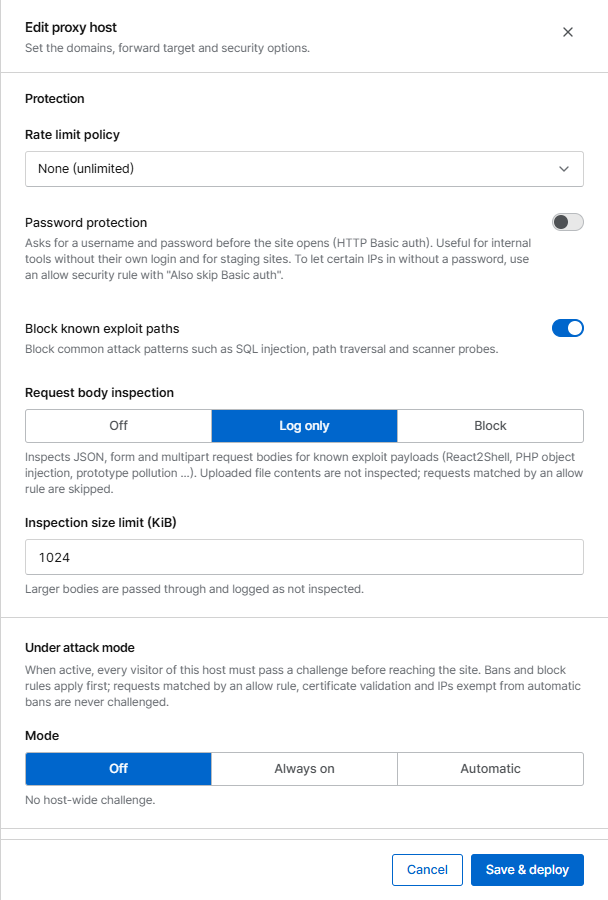
Under attack mode challenges every visitor of a host. Set it in the proxy host form under Protection → Under attack mode.
| Mode | Behaviour |
|---|---|
| Off | No host-wide challenge (default) |
| Always on | Every request without a pass gets the challenge. Turn it on while you are under attack |
| Automatic | Turns on by itself when requests per second or the share of blocked requests goes above a threshold, and off again once traffic has stayed below for the activation period |
Automatic mode settings:
| Setting | Default |
|---|---|
| Requests per second | 200 |
| Blocked share | 50 % (0 = not used) |
| Window | 30 seconds |
| Stay on for | 15 minutes, extended while still above a threshold |
When it turns on or off you get an alert, and the dashboard shows a banner. Deactivate now ends an automatic activation early.
Never challenged: requests an allow rule matched, certificate validation, and IPs in the automatic-ban exemptions.